Crypto PortfolioNovember 24, 2026
22
6 min read
You bought some Bitcoin because everyone was talking about it. Then some USDT because the naira kept moving. Then a friend told you about BNB, so you bought that too.
Now you own several coins. But do you have a portfolio, or just a pile? According to Breet Crypto Adoption Report, 2025, around 22 million Nigerians hold crypto. Bitcoin is the most widely held, with 76% of Nigerian crypto owners holding it, followed by Ethereum at 50%. Stablecoins like USDT account for 43% of retail crypto transactions, because many people use crypto for everyday money rather than pure investing. Many of these people hold several coins, but not all have a plan behind them.
This guide explains what a crypto portfolio is, why having a plan matters, and how to build a simple one that fits your goals and your risk.
A crypto portfolio is simply all the crypto assets you hold, viewed together and managed with a plan. A pile is a random collection. A portfolio has a purpose: each holding is there for a reason, in a size you chose.
Simple analogy: Think of a trader in the market. One who stocks only tomatoes is in trouble the day tomatoes stop selling. A trader with a mix of goods, some fast-selling and some steady, can survive a bad week for any one item. A portfolio works the same way. You spread your money so no single bad moment can wipe you out.
• It manages risk. Prices of different assets do not all move at the same time or by the same amount.
• It gives you a plan. You know what you own, why you own it, and when you would sell.
• It cuts down on emotional decisions. Chasing whatever is trending usually means buying near the top.
• It matches your goals. Protecting savings, growing wealth, and earning from trading are different goals, and they call for different mixes.
This is the most common beginner mistake. Ten different coins do not make a diversified portfolio if they all fall together.
Research on crypto portfolios shows that during market stress, the prices of Bitcoin and many altcoins can become highly correlated, with correlations climbing to between 0.75 and 0.90. In simple terms, when Bitcoin drops sharply, most other coins tend to drop with it, and often by more. Real diversification means holding different kinds of assets that play different roles, not just a longer list of coins.
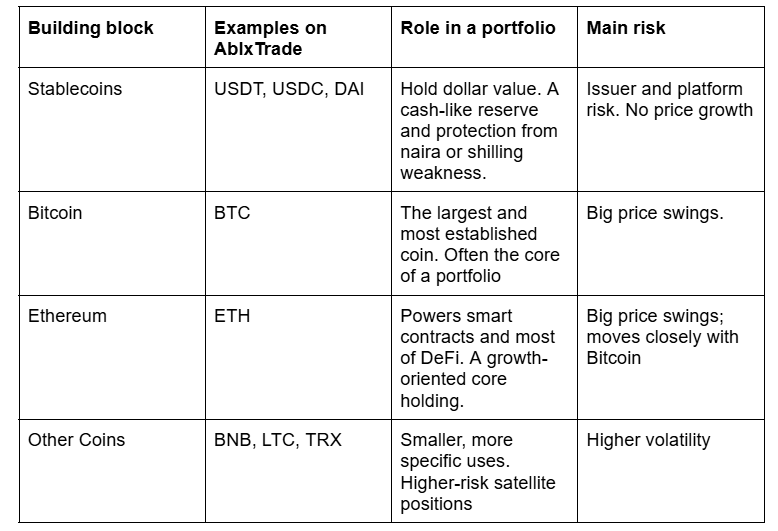
Most simple portfolios are built from a few asset types. Here are those available on AblxTrade:
One widely used way to organise a portfolio is called core-satellite. The core is the stable, established base. The satellites are smaller, riskier positions around it.
A commonly cited beginner example splits a crypto portfolio roughly 60% in Bitcoin as the core, 30% in Ethereum and other large, established coins, and 10% in small, speculative coins. The idea is that if the entire speculative 10% is lost, the rest of the portfolio stays intact. Many frameworks also hold a reserve of around 10% to 20% in stablecoins, so you have money ready to buy when prices drop without selling your core.
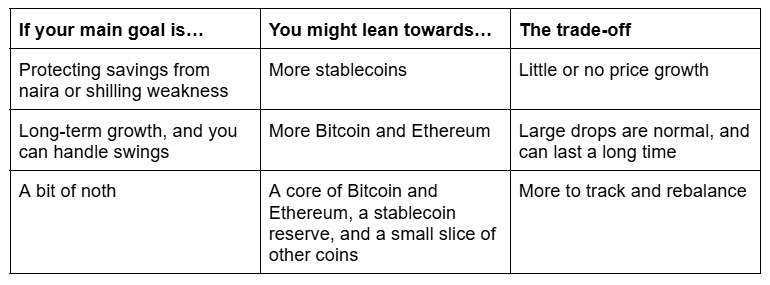
1. Get the basics in place first. Build an emergency fund that covers a few months of expenses before you invest. Only invest money you can afford to lose.
2. Define your goal and timeline. Are you protecting savings, building long-term wealth, or both? Will you need the money in six months or in five years?
3. Choose your risk level honestly. If a 50% drop would make you panic and sell, a smaller allocation to volatile coins suits you better.
4. Start small and simple. A handful of assets is easier to understand and track than a long list. Add more only when you can explain why each one is there.
5. Decide how you will buy. Buying in regular instalments, known as dollar-cost averaging, takes the pressure off timing.
6. Secure what you hold. Protect your wallet, never share your seed phrase, and write down where your assets are.
7. Write it down. Note what you bought, when, at what price, and why. Regulators in both countries are tightening crypto rules and reporting, so good records also help you later.
8. Review and rebalance every few months. If a coin has grown far beyond its planned share, you can sell some and move the money back to your target mix. Do this on a schedule, not whenever the market makes you nervous.
Over time, some assets grow faster than others, and your mix drifts away from your plan. Say your plan was 60% Bitcoin, but after a rally in smaller coins, Bitcoin is only 45% of your portfolio. Rebalancing means selling some of the coins that grew and buying more Bitcoin to bring the mix back to your target.
Rebalancing costs money in fees, so do it occasionally, such as every three to six months, rather than constantly.
• Chasing trending coins. By the time a coin is all over social media, much of the move may be over.
• Holding too many coins. You cannot track what you do not understand.
• Ignoring stablecoins. A stablecoin reserve gives you flexibility in both good and bad markets.
• Forgetting about fees. Network fees, platform fees, and deposit fees all add up, especially on small, frequent transactions.
• Investing money you need. Rent, school fees, and emergency money do not belong in a portfolio.
• Trusting guaranteed returns. Nobody can promise profit in crypto. Anyone who does is a red flag.
AblxTrade supports Bitcoin, Ethereum, BNB, USDT, USDC, DAI, Litecoin, and Tron. You can buy supported coins with your naira wallet balance, and convert them back to naira or KES when you need cash.
AblxTrade is a conversion platform, which means it does not store crypto for you. If you plan to hold coins for the long term, you will need your own wallet, so learn how to keep it secure.
What is Dollar-Cost Averaging?
USDT vs Bitcoin: Which should you hold?
What is a Bull Market and a Bear Market?
What is a Private Key? Why you should never share your seed phrase.
Not financial advice
This article explains how a crypto portfolio works. It is not financial advice, and the example allocations are for illustration only. Crypto prices can fall as well as rise, and you can lose money. Only use money you can afford to lose.
Ready to explore cryptocurrency opportunities in Africa? ABLX provides secure, user-friendly platforms for trading and managing your digital assets.

Explore more insights about cryptocurrency, blockchain, and financial technology in Africa.