Private KeyNovember 11, 2026
29
5 min read
A message arrives from “support”. Your wallet has a problem. To fix it, they just need your 12 words.
Every year, people lose everything they own in crypto to that one message. It works because most people were never told what those words actually are.
Chainalysis estimates crypto scams took around $17 billion in 2025, with at least $14 billion confirmed on-chain. Separately, wallet drainer phishing alone cost victims about $84 million across more than 100,000 people that year. Losses from drainers fell sharply, but security researchers say the threat remains active.
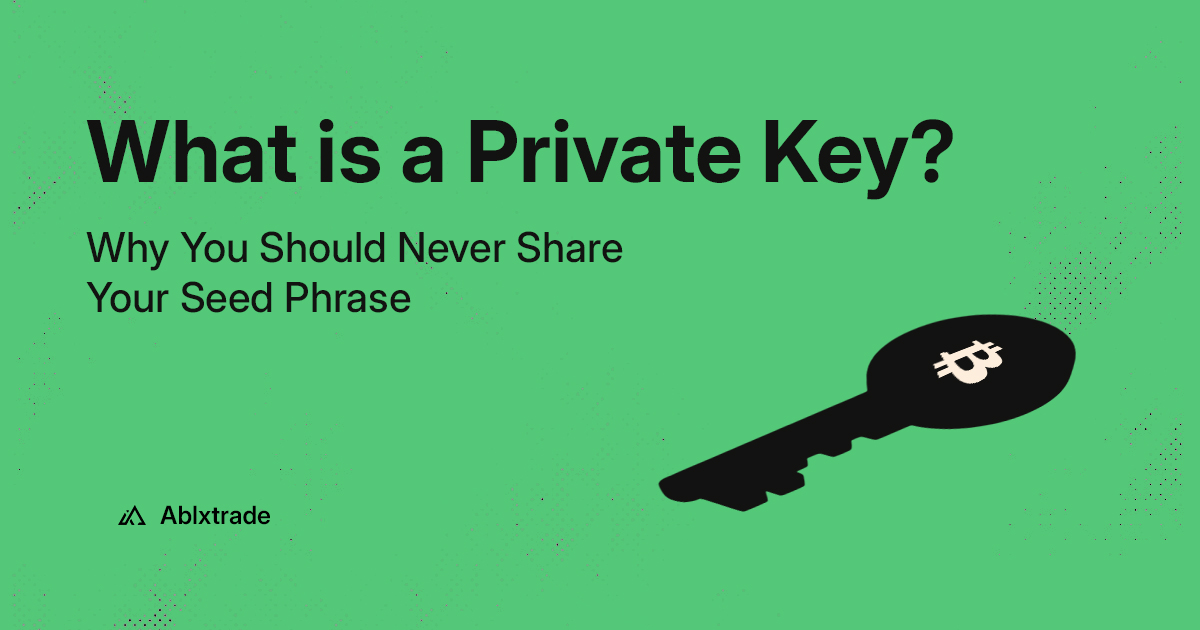
This guide explains what a private key and a seed phrase are, why they must stay secret, how scammers try to get them, and how to stay safe.
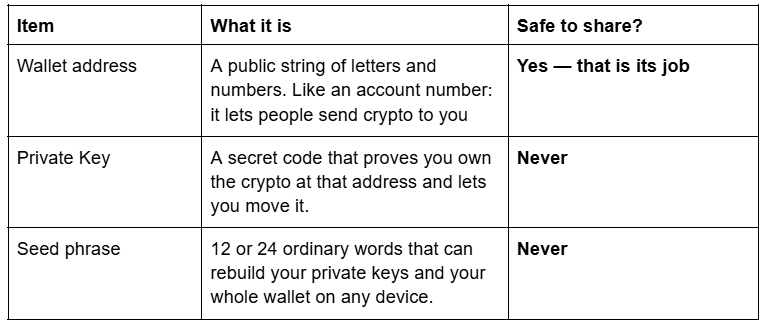
A private key is a long, secret code that proves you own the crypto at your wallet address. Whoever holds the key can move the funds. That is all the blockchain checks. It does not ask who you are, and it does not care how someone got the key.
Simple analogy: Your wallet address is like your bank account number. You can give it to anyone so they can pay you. Your private key is like your ATM PIN and your signature rolled into one. The difference is that a bank can freeze or reverse a payment. On a blockchain, nobody can.
Nobody wants to store a long string of random characters, so most wallets give you a seed phrase instead. It is a list of 12 or 24 ordinary English words, such as the ones you see when you set up a new wallet.
Those words are a backup of everything. They can rebuild your private keys and, with them, your whole wallet, on any phone or device. That is why a seed phrase is just as powerful as a private key. Anyone who has the words has your money.
• There is no undo. A crypto transfer cannot be reversed. There is no bank to call and no chargeback.
• There is no customer service that can help. Real wallets and platforms do not hold your seed phrase, so they cannot recover it for you or need it from you.
• It is fast. Once someone has your words, they can restore your wallet on their own device and empty it in minutes.
• It works from anywhere. The thief does not need your phone, your password, or your SIM.
• Fake support. Someone on Telegram, WhatsApp, X, or Instagram claims to be from your wallet or exchange. They say there is a problem and they need your phrase to “fix” it.
• Fake wallet apps and websites. A page that looks like your wallet asks you to “verify” or “sync” your wallet by typing your words.
• Giveaways and airdrops. “Claim your free tokens” links that ask you to connect your wallet or enter your phrase.
• Recovery scams. After you lose money, someone offers to get it back for a fee and asks for your details.
• Pressure and urgency. “Your wallet will be locked in 10 minutes.” Real problems do not come with a countdown.
NB: It is not only about seed phrases. Many modern scams no longer ask for your words. Instead, a fake website asks you to sign a message or approve a transaction, which quietly gives the scammer permission to move your tokens. If a site asks you to sign something you do not understand, close it.
1. Never type your seed phrase into a website, app, chat, or form. The only time you enter it is when you restore your own wallet inside the official wallet app.
2. Write it on paper. Do not screenshot it, save it in your notes app, email it, post it on WhatsApp, or store it in cloud storage. Anything connected to the internet can be hacked.
3. Keep it somewhere safe. Many people keep two copies in two secure places. Never keep a photo of it on your phone.
4. Download wallets only from official sources. Use the App Store or Google Play and check the developer name. Fake wallet apps exist.
5. Test with a small amount first when you use a new wallet or address.
6. Think about a hardware wallet if you hold a large amount for the long term. It keeps your keys offline.
7. Remember the rule. No real support agent, developer, or platform will ever ask for your seed phrase. If someone asks, it is a scam.
Act quickly. Create a brand new wallet with a new seed phrase, then move your funds there as soon as you can. Do not keep using the old wallet, because anyone who has the old words still controls it. If you signed a suspicious approval, revoke it using a trusted tool and move your funds anyway.
AblxTrade is a conversion platform. It does not store your crypto, and it does not hold a crypto wallet for you. For each trade, it generates a temporary wallet address that is valid for 24 hours and cannot be reused. You send your crypto to that address from your own wallet, and the naira lands in your AblxTrade wallet.
That means the seed phrase you need to protect is the one for your own external wallet, such as Trust Wallet or any other you use to hold crypto. AblxTrade does not need it.
Convert crypto without storing it with us. Sell Bitcoin, USDT, Ethereum, BNB, and more on AblxTrade. A fresh address for every trade, and you see your naira value before you confirm.
Ready to explore cryptocurrency opportunities in Africa? ABLX provides secure, user-friendly platforms for trading and managing your digital assets.
Explore more insights about cryptocurrency, blockchain, and financial technology in Africa.