USDT vs Bitcoin NigeriaNovember 5, 2026
2
5 min read
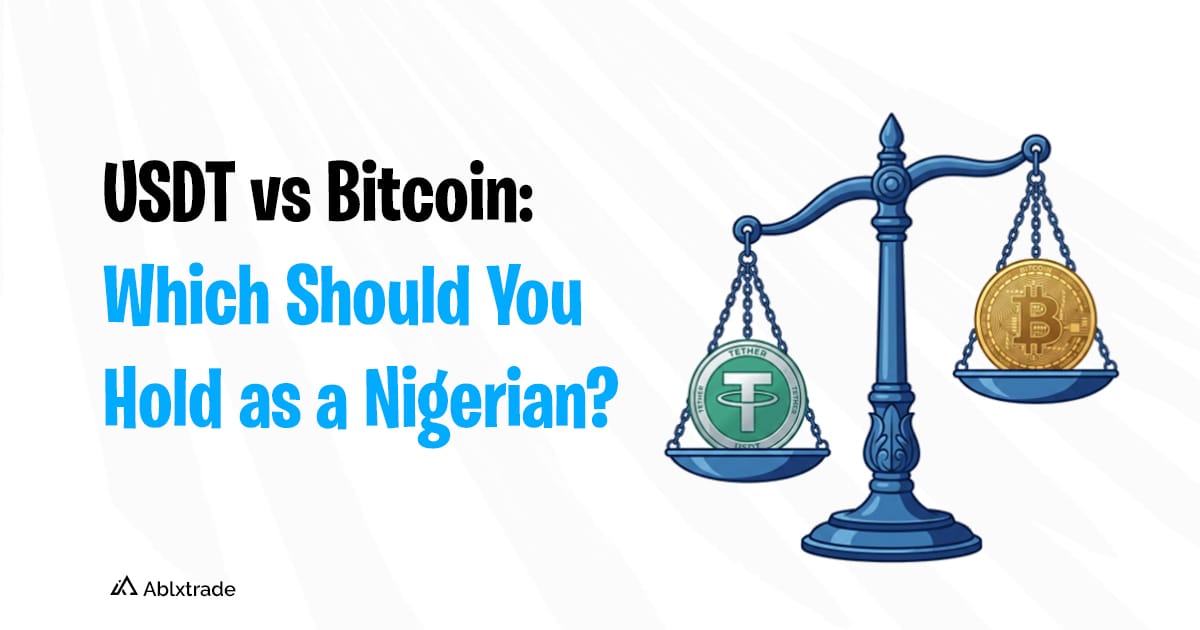
If you have spent any time in Nigerian crypto circles, you have heard both sides of this debate. Bitcoin believers will tell you it is the future of money and the greatest store of value ever created. USDT users will tell you stability matters more than potential gains when the naira is already losing value.
Both have a point. And both are right. For different reasons and different people.
This guide breaks down the real differences between USDT and Bitcoin in the context of what Nigerians actually use crypto for: protecting savings from naira depreciation, receiving money from abroad, trading, and converting quickly to cash.
The Nigerian context
Around 22 million Nigerians now hold cryptocurrency, which is roughly 10.3% of the population. Bitcoin is the most widely held, with 76% of Nigerian crypto owners owning it. Yet stablecoins like USDT account for 43% of all retail crypto transactions in Nigeria, as many Nigerians use them for everyday financial activity rather than investment.
Sources: Breet Crypto Adoption Report, 2025 | Tangem Blog, April 2026
Bitcoin (BTC) is the world’s first and most well-known cryptocurrency. Created in 2009, it is often called “digital gold” because, like gold, there is a limited supply. Only 21 million Bitcoin will ever exist. This scarcity is a core reason people hold it as a long-term store of value.
Bitcoin’s price is volatile. It can gain or lose 20–30% of its value within days. For Nigerians who remember Bitcoin trading below ₦1 million and watching it climb above ₦100 million in early 2026, the upside potential is clear. So is the risk.
USDT (Tether) is a stablecoin, a cryptocurrency designed to always be worth exactly $1. Unlike Bitcoin, its value does not fluctuate. One USDT today is worth the same as one USDT tomorrow.
For Nigerians, USDT has become the practical alternative to a domiciliary account. With the naira losing over 40% of its purchasing power between 2023 and 2025, millions of Nigerians have moved a portion of their savings into USDT simply to preserve their dollar value without the risk of Bitcoin’s price swings.
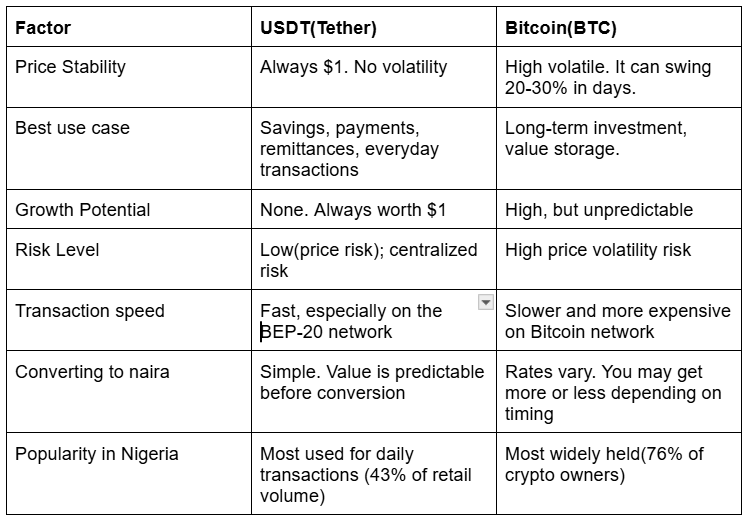
For most Nigerians who want to convert crypto to naira quickly, USDT is the more predictable choice. Because its value is fixed at $1, you know exactly how much naira you will receive before you initiate the transaction. With Bitcoin, the naira equivalent changes by the minute depending on market price; you might get more than expected, or significantly less.
That said, if you hold Bitcoin and the price has risen since you received it, converting at the right time could yield more naira than USDT would. It requires timing and market awareness that USDT simply does not.
USDT is best for:
Nigerians who want to protect their savings from naira depreciation without taking on price risk. Freelancers who receive payments in crypto and want stability. People who receive money from abroad regularly and need to convert to naira predictably. Anyone who wants a digital dollar savings account without the complexity of a domiciliary account.
Bitcoin is best for:
Nigerians who are comfortable with volatility and are thinking long-term — five years or more. Those who want exposure to potential price appreciation beyond the dollar. People who can afford to hold without needing to convert to naira urgently. Investors who already have a stable savings base and want to add a growth asset on top
Yes, and honestly, many Nigerians do. A common approach is to keep the majority of crypto savings in USDT for stability, and allocate a smaller portion to Bitcoin for growth potential. This way, you are protected from naira depreciation while still having exposure to Bitcoin’s upside.
The right split depends on your risk tolerance, how soon you might need to convert to naira, and how comfortable you are watching your balance fluctuate.
AblxTrade is a non-custodial platform. It does not hold USDT or Bitcoin on your behalf. When you use AblxTrade to receive crypto, whether USDT, Bitcoin, or any other supported coin, it generates a temporary wallet address valid for 24 hours. Once the crypto arrives, AblxTrade converts it to naira automatically and credits your wallet. The crypto itself is never stored.
This means AblxTrade is ideal for the conversion step, turning your USDT or Bitcoin into spendable naira quickly, but not for long-term crypto storage. For storage, you will need an external wallet like Trust Wallet or a hardware wallet.
Read our guide: What Is a Crypto Wallet? A Simple Guide for Nigerians. It explains the difference between storage wallets and AblxTrade’s temporary conversion wallet in plain English.
Do you have USDT or Bitcoin you want to convert to naira? AblxTrade converts both to naira instantly. No storage, complexity, or stress.
Ready to explore cryptocurrency opportunities in Africa? ABLX provides secure, user-friendly platforms for trading and managing your digital assets.
Explore more insights about cryptocurrency, blockchain, and financial technology in Africa.