Dollar-Cost AveragingNovember 17, 2026
12
5 min read
“Should I buy now, or wait for the price to drop?”
Almost everyone who buys crypto, or any asset, asks this question. The honest answer is that nobody knows. Professionals get it wrong all the time. Dollar-cost averaging is a simple way to stop depending on the answer.
This guide explains what it is, how it works, what the evidence says, and how it applies to buying USDT or Bitcoin in Nigeria and Kenya.
Dollar-cost averaging, or DCA, means investing the same fixed amount at regular intervals, regardless of what the price is doing. Instead of trying to find the perfect moment to buy, you buy a little on a schedule: for example, $50 of USDT or Bitcoin on the same day every month.
When the price is low, your fixed amount buys more units. When the price is high, it buys fewer. Over time, your average buying price smooths out.
Simple analogy: DCA is ajo, esusu, or chama for your investments. You put in the same amount on the same day, whether the month was good or bad. You do not wait until you feel rich or until the timing feels right. The discipline does the work.
Imagine you put $100 into a coin every month for four months, and its price moves like this:
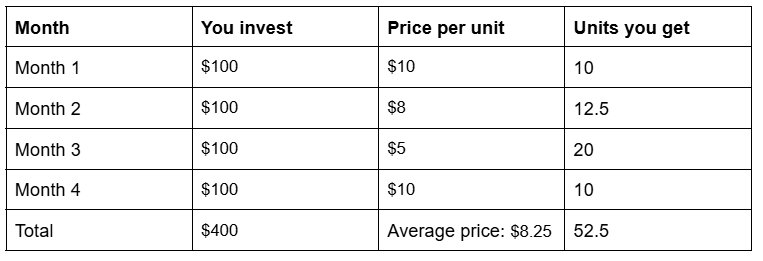
You spent $400 and got 52.5 units, so your average cost is about $7.62 per unit. That is lower than the $8.25 simple average of the four prices, because your fixed amount automatically bought more when the price dipped to $5.
If you had put all $400 in at once in Month 1 at $10, you would have 40 units. In this example, DCA came out ahead. But if the price had simply climbed every month, the lump sum would have won. DCA does not beat the market. It manages how much timing risk you take.
• Removes the pressure of timing. You do not have to guess the bottom.
• Builds discipline. A schedule keeps you investing when fear or excitement says otherwise.
• Fits how most people earn. Most Nigerians and Kenyans get paid monthly or in bits. Few have a big lump sum sitting around. DCA turns your income into a habit.
• Reduces regret. If the price drops right after you buy, you still have more money going in at the lower price.
• It does not guarantee a profit. If an asset keeps falling for years, you keep buying something that keeps losing value.
• It does not usually beat a lump sum in a rising market. Money that waits to be invested misses the early gains.
• It cannot make a bad asset good. DCA is a way of buying, not a reason to buy.
Crypto is far more volatile than the stocks and bonds in the Vanguard research, which is the main reason DCA is so popular with crypto holders. Bitcoin hit about $126,000 in October 2025, fell to roughly $64500 by June 2026, and has since recovered to the mid $80,0000. Someone who put everything in at the top had a very different experience from someone who bought a little every month through the whole cycle.
Even so, volatility cuts both ways. DCA does not remove the risk that a coin loses value, and it is not a reason to put in more than you can afford to lose.
DCA works differently with a stablecoin. USDT stays at about $1, so there is no coin price to average. What does move is the naira-to-dollar rate (and the shilling-to-dollar rate in Kenya).
If you buy dollars in USDT a little at a time instead of all at once, you also average the rate you paid. You are not betting on a price. You are spreading out the risk of converting everything on a bad day, and building a dollar balance steadily from your income. Stablecoins carry their own risks, which we cover in our guide to stablecoins.
1. Decide an amount you can afford to lose. Do not use rent, school fees, or emergency money.
2. Choose what to buy. USDT for dollar savings, or a coin like Bitcoin or Ethereum if you accept the price swings.
3. Pick a schedule that matches your income. For most people, monthly after payday is realistic.
4. Mind the fees. Fixed fees take a bigger bite out of small, frequent purchases. For example, a ₦100 fee on a ₦5,000 deposit is 2%, but only 0.5% on ₦20,000. A monthly or fortnightly schedule often works out cheaper than a weekly one.
5. Set a reminder and keep going. The method only works if you stick to it, especially when prices fall.
6. Keep records. Note the date, amount, and rate each time.
7. Review every few months, not every day. Checking prices constantly makes it harder to stay on schedule.
Beware of “auto-DCA” scams
Be careful with any platform or person that promises guaranteed returns from a “bot” or “automatic investing” scheme. DCA is a buying habit, not a profit machine. Nobody can guarantee returns, and anyone who does is a red flag.
You can buy supported cryptocurrencies with your naira wallet balance. To DCA, you fund your wallet on your payday and buy the same amount on your chosen date, then repeat each period. At the moment, you set the schedule and reminders yourself.
Keep in mind that AblxTrade is a conversion platform, so it does not store crypto for you. If you want to hold what you buy for the long term, you will need your own wallet, and you should protect it carefully.
Ready to explore cryptocurrency opportunities in Africa? ABLX provides secure, user-friendly platforms for trading and managing your digital assets.

Explore more insights about cryptocurrency, blockchain, and financial technology in Africa.